Case Study
Reviving my mum's 25-year-old art website
A handmade art zine from 2001 was slowly dying on an old host. I restored all 445 pages exactly as she made them, and rebuilt everything underneath.
The client
My mum was building websites before I was.
In 1999 she helped me make my first one. There were no tutorials then, no YouTube, no AI to ask. She figured out the code and the hosting by staying up until 4am until it worked. She was in her fifties and teaching herself from nothing, and I have never stopped respecting that.
From 2001 to 2009 she ran art-e-zine, an online magazine for altered books, artist trading cards, collage and mail art. She built every page herself in an early visual editor, one artwork at a time. Hundreds of artists from around the world sent in their work. By the end it held 445 pages and around 8,500 images.
Then life moved on and the site sat untouched for fifteen years.
The problem
The internet had not forgotten the site. 599 websites still linked to it. People still landed on it every day.
But the site itself was falling apart:
- No SSL. Browsers showed security warnings on every page, and the certificate could not be fixed without touching twenty-year-old DNS settings that also carried her email.
- Built in software that no longer exists. Every page was absolutely positioned for an 800 by 600 screen, in markup no modern tool understands.
- Broken on mobile. The fixed layouts were designed for a 2001 monitor. On a phone, text and images piled on top of each other and you could not read or see anything. Most visitors today arrive on a phone.
- Hard to read, by design. Her collage aesthetic was the whole point of the site, but it meant text often sat directly on busy background artwork and clashed with it. I was not willing to change the design to fix it.
- Full of dead weight. Old visitor counters were still calling servers that no longer exist. Hidden inside 120 pages, the counter service had planted spam links to casino and loan sites. Text was littered with broken characters from a 2001 character encoding.
- No structure. There was no navigation beyond a long contents list and a chain of “new stuff” pages, one for each year. Under that was a labyrinth of 445 pages with no thematic organisation and no way to browse by subject. If you did not already know a page existed, you would never find it.
The obvious move was a modern rebuild. But a modern rebuild would have erased the thing people loved about it.
The decision
The rule for the whole project: preserve the original exactly, rebuild everything underneath it.
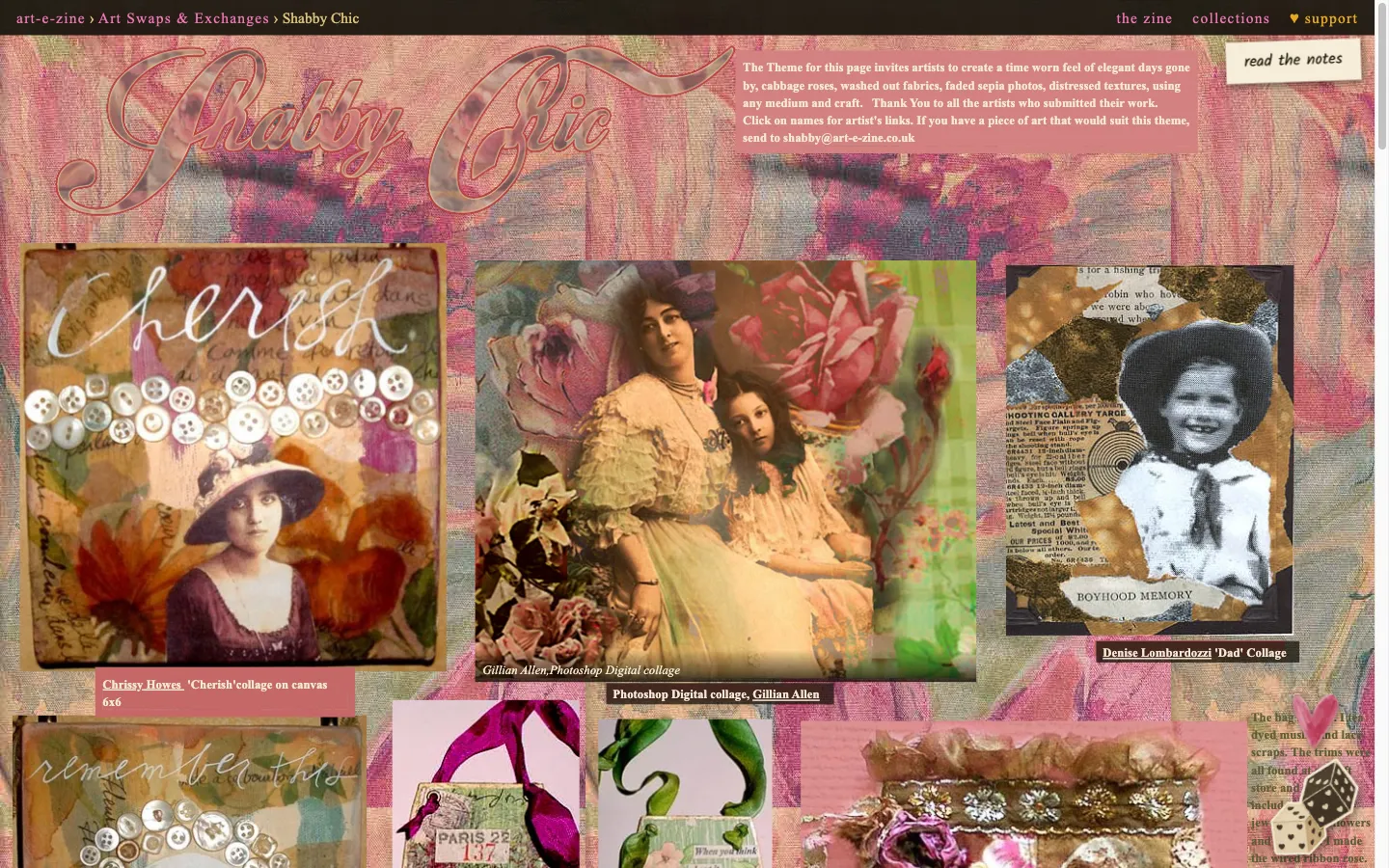
Her layouts, her colours, her tiled backgrounds, her Times New Roman, even the “best viewed at 800 x 600” note stay as she made them. The engineering brings them to 2026.
The rebuild
I wrote a converter that reads her original page-builder markup and regenerates each page:
- Every composition preserved at its exact coordinates, scaled to fit any screen. Artist credits stay with every artwork.
- A “read the notes” overlay on every page. The original text was trapped inside fixed layouts, often sitting on top of busy artwork. Instead of touching her design, every page got a readable, printable version of its words, one click away. It also makes 25 years of writing visible to search engines for the first time.
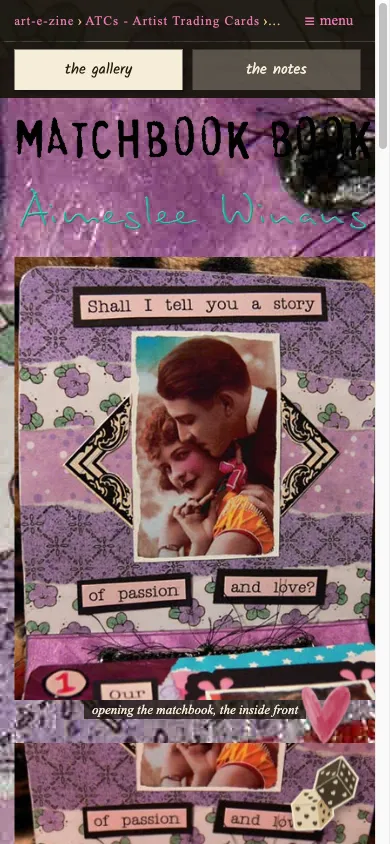
- A proper mobile version. Rather than letting the fixed layouts collapse into a jumble, each page becomes two swipeable panes on a phone: the art and the words. Nothing is cut, nothing overlaps.
- A lightbox on every artwork. Click any image on any page and swipe through everything on that page as a gallery, full screen, with the artist’s name on each image. Keyboard on desktop, swipe on mobile.
- Every original URL kept. All 445 pages answer at the same addresses they had in 2001, so 25 years of links from 599 other websites still work. A full audit shows zero broken internal links.
- Structure the site never had. I catalogued all 8,500 images by theme and found the organisation that was already there in her content: 18 collections, from artist trading cards to vintage ephemera. Each collection is now a hub page where every archive page appears as a clickable card with its own artwork. The content did not change. It just became findable.
Around the pages themselves:
- Cleaned the text sitewide. Removed the spam and dead trackers from 120 pages, repaired more than 1,500 broken characters, and fixed around 700 typos while keeping her voice and her spelling quirks intact.
- Tidied the dead external links. The site links out to hundreds of artist websites, and many of those have vanished over 25 years. Dead links now point at their Wayback Machine archives, so the trail of credits still leads somewhere.
- Recovered what was lost. Missing images came back from the old server and from Wayback Machine captures, including background artwork that had been dead since 2011. My own art pages were rebuilt from recovered files.
- Moved the domain with zero downtime. Email first, then DNS, in stages, with a rollback at every step. Her email address never stopped working. SSL now renews itself.
- Made it fast and free to run. Every one of 8,352 JPEGs was losslessly optimised, cutting 68MB with identical pixels. The site now serves from edge hosting with no monthly cost, saving her around £100 a year in hosting fees. Her only bill is the domain name.
The highlights
The archaeology
Old websites accumulate strange things. The free visitor counters she installed in 2006 turned out to hide spam links for casinos and payday loans inside the page code, invisible to her, visible to Google. Finding and stripping that junk from 120 pages was one of the most satisfying parts of the project.
Lost artwork, found
Fifteen background artworks had been missing from the server for over a decade, leaving some pages black on black and unreadable. Thirteen came back from Wayback Machine captures, byte for byte. The pages look as she designed them for the first time in years.
The dice
The zine was never meant to be read in order. It grew page by page for eight years, and the joy of it was stumbling onto things. So every page has a small dice button, drawn by hand, with hearts for pips. Press it and the site takes you to a random page from the archive. Press it again and again.
It is the simplest feature on the site, and it is my favourite. It turns 445 pages of archive back into what it originally was: a place to wander.
Support the zine
The site now has a small way to give back. A donate button leads to a pack of 500 vintage images from the archive as a thank you, delivered automatically after a PayPal donation. No storefront, no accounts, in keeping with how the zine always worked.
The results
The launch measures are about preservation, not growth:
| What | At launch |
|---|---|
| Pages restored | 445, all at their original URLs |
| Broken internal links | 0 |
| Referring domains preserved | 599 |
| Images served | ~8,500, losslessly optimised, 68MB lighter |
| Hosting cost | £0, around £100 a year saved |
| Email downtime during migration | none |
Every page now has a unique title, description and social preview, and a sitemap points search engines at all of it. Traffic numbers will follow once the site has been indexed in its new home; this page will be updated.
The result that matters most does not fit in a table. The site my mum made is back, exactly as she made it, and it will not fall apart again.
A look at the site
Like what you see?
Let's build yours