Your customers have changed how they find businesses like yours.
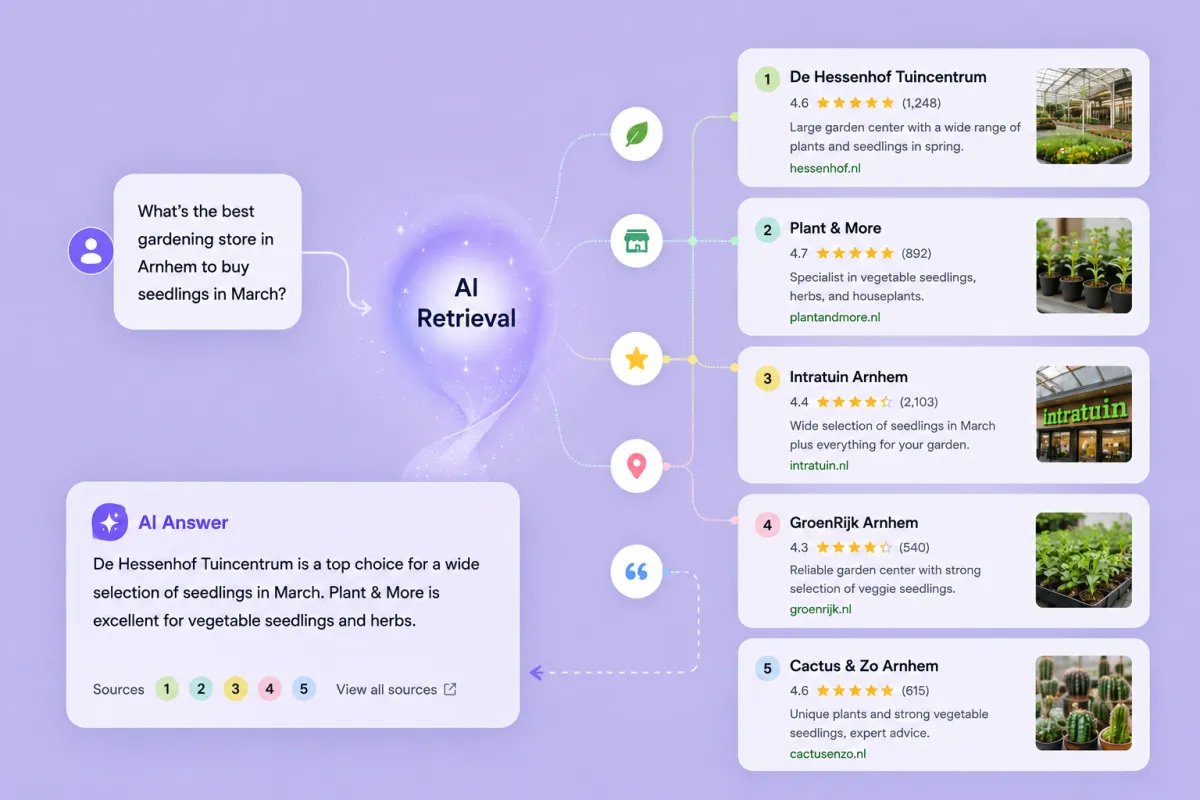
Instead of Googling, more people are turning to GenAI platforms like ChatGPT or Claude to ask: “who’s the best [what you do] in [city]?” or “I’ve got [problem], who should I see?” And even a Google search now returns an AI summary at the top of the page, so more journeys end in a “zero-click” search with no visit to any website at all (up from around 45% of searches a decade ago to roughly 68% in 2026). Whatever the AI says back is the shortlist. If you’re on it, you’re in the running. If you’re not, you’re invisible.
Here’s the part that works in your favour: getting picked has surprisingly little to do with being the biggest brand or having the most “authoritative” website. AI citations run on a different paradigm to traditional SEO.
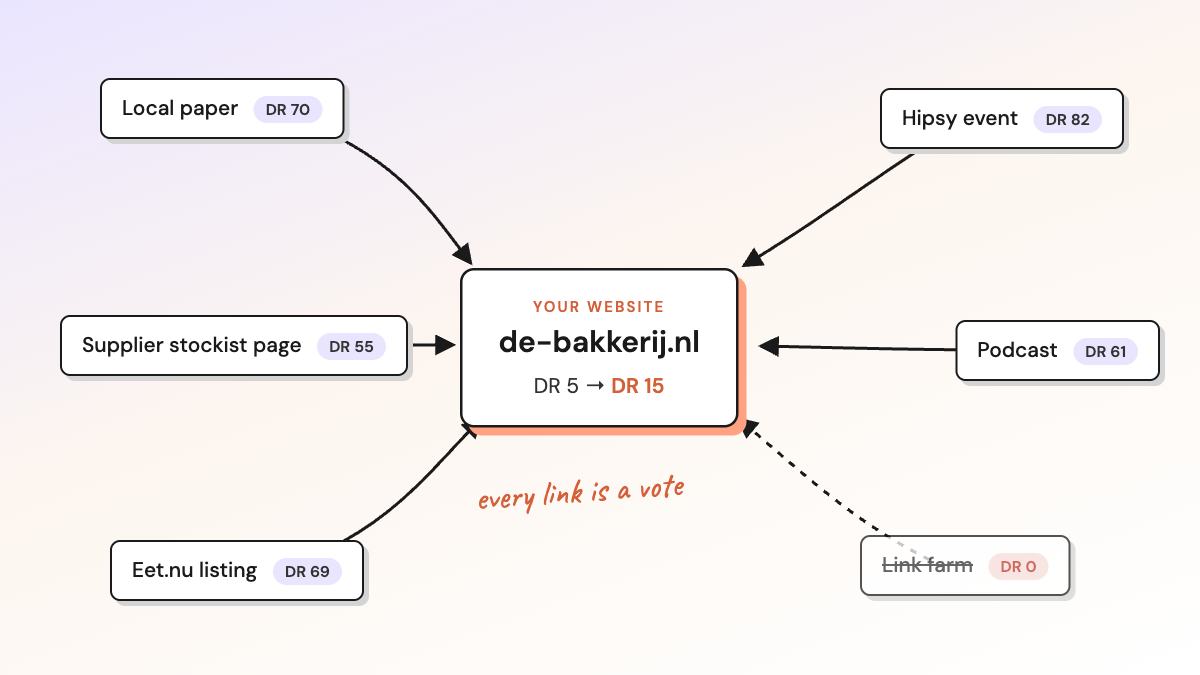
While domain authority and backlinks – things that can take years to build and compound – are major levers in Google’s algorithm, AI is more likely to retrieve citations from content with the right structure and level of specificity.
Remarkably, two large analyses, one of 10 million AI search results and one of 15,000 queries, both found that only around 12% of the pages ChatGPT cites also rank on Google’s first page.
The obstacle to being discovered isn’t your authority, it’s whether you are the clearest, most specific answer to the question. That is a fight a smaller business can genuinely win, while most of your competitors haven’t started.
The short version (TL;DR)
Getting recommended by AI is something a small business can genuinely win, because these tools quote the clearest, most specific pages, not necessarily the most authoritative ones. In brief:
- AI reads your site in fragments and quotes the best individual passages, so write self-contained, answer-first chunks.
- Be specific and go deep: real prices, numbers and detail, on pages that fully answer one topic.
- Add extensive FAQs, keep your facts identical everywhere, and if you’re local, get your Google Business Profile and reviews in order.
- Make sure your site is technically readable: i.e., your content in the HTML (not hidden behind JavaScript), structured data in place, no dead links.
- Start this week by expanding your FAQs and asking ChatGPT, Gemini and Perplexity what they already say about you.
How AI search actually works
Two things about how these tools work explain every tactic that follows.
Where AI gets its answers
There are a few different ways your business can end up in an AI’s answer, and they are not equal. Some of what an AI “knows” is baked into its training data, the snapshot of the world it learned from when it was built. You have no influence over that. It is frozen, often many months out of date, and you cannot edit your way into it.
What you can influence is retrieval: the moment an AI runs a live web search, or fetches a specific page as a tool, mid-answer, to ground its response in something current. This happens constantly now. Ask ChatGPT, Perplexity, Copilot or Google’s AI about a particular business, or “the best [X] in [city]”, and they will almost always go and look rather than answer from memory. That live search is the opening, and everything in this guide is about winning it.
It reads passages, not whole pages
So how does that retrieval actually work? AI doesn’t read your page the way a person does, start to finish. It breaks every page into small fragments, scores each fragment against the question someone asked, and quotes the strongest individual fragments, often pulling from several different sites in a single answer.
So it isn’t choosing the best website. It’s choosing the best passages. The entire game is to fill your site with self-contained, genuinely useful passages that are easy to lift out and quote.
A case study: the brand that didn’t exist
In late 2025, a researcher at Ahrefs, Mateusz Makosiewicz, invented a fake luxury brand called Xarumei, gave it an AI-generated website, and seeded a few conflicting, made-up stories about it across a blog, Reddit and Medium. Then he asked eight AI assistants 56 questions about a company that did not exist.
They answered confidently, repeating the invented details as fact, and often preferred the fabricated third-party stories over the brand’s own official FAQ, which explicitly denied them. Months later, even after the hoax was made public, many of the tools still treated Xarumei as real.
The headline grabs you (“AI repeats lies”), but the more useful lesson is the one Search Engine Journal drew out: the fake content won because it was more detailed and answer-shaped than the real source, not because it was more authoritative. AI reached for whatever was specific and quotable. That is the whole opportunity here: feed it the clearest, most specific, and (unlike Xarumei) genuinely true version of your story, and you become the source it reaches for.
There are eleven levers that can get you there, starting with the ones you can do yourself.
1. Lead with the answer
The pages that get quoted put the answer first (RIP to the recipe blogs with a 1,000-word preamble before finally sharing that keto tiramisu). There are two halves to getting this right.
Put the answer in the first sentence
Open every section with a direct, useful answer, then explain underneath it. A model scores each chunk on its own, so a section that buries its answer in the third paragraph loses to one that states it up front. A good test: if you lifted the first sentence of a section out on its own, would it still tell someone something useful? If not, rewrite it until it does.
Write your headings as the questions people ask
A heading that reads like a real search, “Does a sports massage help shin splints?”, matches what someone actually types far better than a label like “Our techniques”. The closer your heading is to the question in someone’s head, the more likely your section is the one that gets pulled into the answer. Go through your key pages and turn vague headings into the actual questions your customers ask.
2. Go deep, not broad
When someone asks AI a question, it fans that question out into smaller ones. “Does shockwave therapy help plantar fasciitis?” becomes what it is, the evidence, the cost, the number of sessions, what to expect afterwards. The page that answers the most of those sub-questions wins.
This is why a thin services page that lists what you offer rarely gets cited, while one thorough page on a single topic does. You don’t need a hundred pages. You need your important ones to genuinely exhaust the topic.
3. Be specific, and drop the superlatives
AI quotes specifics and ignores adjectives. “The best massage in town” is noise. “60-minute sessions, €75, most people with lower-back pain need three to five” is exactly the kind of concrete detail it pulls. Prices, durations, what’s included, who it’s for, named techniques, real numbers.
This is measurable, not a hunch: the Princeton and IIT Delhi study that coined the term “generative engine optimization” found that adding statistics, direct quotations and citations to a page raised how often AI quoted it by up to roughly 40%, while keyword-stuffing did nothing.
The more specific and checkable you are, the more quotable you become.
4. Build out your FAQs
If you do one thing, do this. An FAQ is already AI’s preferred shape: a real question, then a short self-contained answer. Most small business sites have three or four. Take your key pages to twelve or fifteen, using the questions clients actually email you and the ones in Google’s “People also ask” box. Every question you answer is another route in. It’s fast, cheap, and out of all proportion to the effort.
5. Use formats that lift cleanly
Some shapes quote better than others. A summary box at the top of a page, your key facts as label-and-value pairs, gives a machine one clean block to pull. Tables win when you’re comparing things, options, types, this versus that, because models lift rows intact. And short paragraphs beat dense blocks, because any one of them still makes sense pulled out alone. You’re not redesigning anything, you’re repackaging what you already know.
6. Be the clearest source of truth about yourself
AI wants reliable facts, so give it them plainly, and make sure they match wherever they appear.
Say the same thing everywhere
Your services, prices, location, hours and positioning should be identical on your site, your Google Business Profile, your socials and any listings. Conflicting details, an old price in one place and different hours in another, are exactly what make a model either get you wrong or skip you for a business whose facts line up. Pick the correct version of each fact and make everything else agree with it.
If you’re local, your Google Business Profile does the heavy lifting
For “who’s good near me” questions, your Google Business Profile and your reviews often carry more weight than your website. Claim the profile, fill in every field (services, hours, area served, photos, the Q&A section), and keep genuine reviews coming. For a local business this is frequently the single highest-impact thing on the whole list.
7. Get talked about off your own site
A model trusts a fact more when it appears in several places, not only on your site. You can’t fully control this, but you can feed it: genuine reviews on the platforms people use, honest mentions in the communities and forums your customers actually read, a creator’s video, reputable directories and professional registers for your field. The aim is consistency, the same accurate story about you turning up in more than one trustworthy place.
8. Make sure AI can even read your site
Crawlers aren’t browsers. Most of the crawlers feeding AI answers won’t see content nested within JavaScript. If a machine can’t read your content, none of the rest of this matters.
Why a finished-looking site can be invisible
If your site builds its content in the browser, with JavaScript fetching and rendering the text after the page loads, the raw HTML a crawler receives can be almost empty. The page looks complete to you and reads as a blank shell to a machine. This is rife in drag-and-drop and AI-generated “vibe-coded” sites, where the polish is all happening client-side, after the page has loaded.
How to check in two minutes
Open one of your pages, right-click, and choose View Page Source (not Inspect). That is the raw HTML, roughly what a crawler sees. Search it for a sentence from your visible content. If the sentence isn’t there, neither AI nor Google can reliably read that part of your page.
How to fix it
The fix is server-side rendering or static pre-rendering, so the words exist in the HTML before any JavaScript runs. It’s a developer job rather than a setting you toggle, and it is one of the most common reasons a perfectly nice-looking small business site gets no AI visibility at all.
9. Add structured data
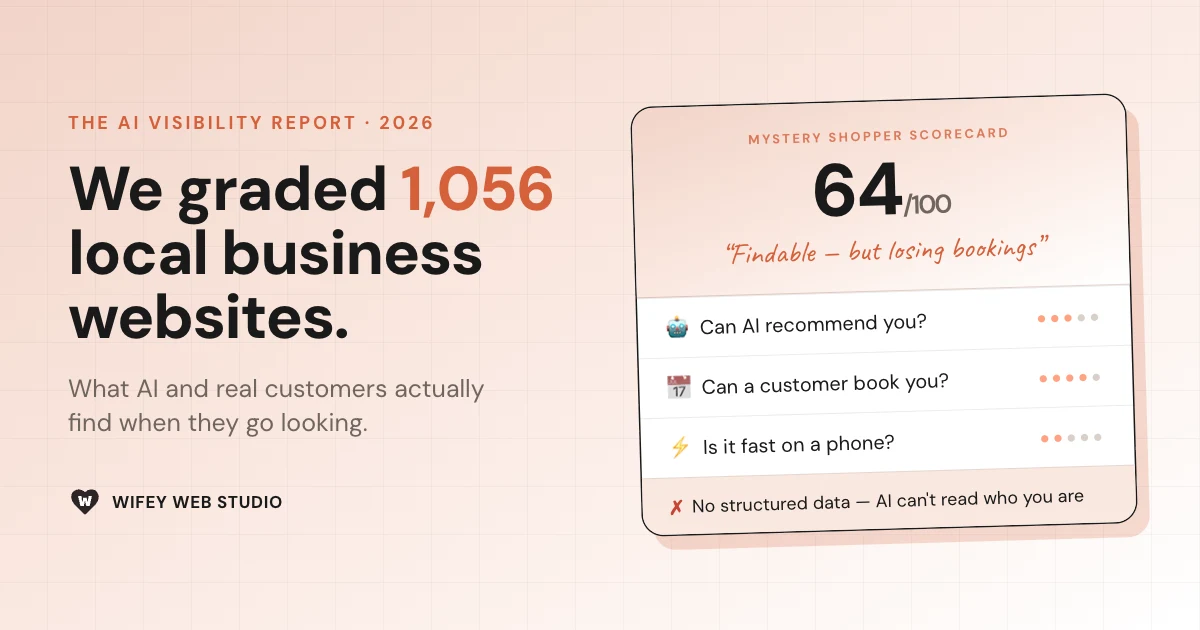
This is the one item here that’s pure code, and it’s also the most commonly skipped: when we audited 1,056 local business websites, more than half had no structured data at all. It’s easiest to take in three parts: what it is, which ones you need, and how to check it.
What is structured data?
Structured data, or schema markup, is code in your page’s head that states your facts in a format machines parse directly instead of having to infer them. None of it shows on the page. It removes the ambiguity about who you are and turns your key facts into something machine-readable rather than a guess.
Which types matter for a small business
The useful ones are LocalBusiness (your name, address, hours and services), FAQPage (your Q&As), Person (the practitioner or owner), and AggregateRating (your reviews). A local service business that gets those four in place has told the machines, unambiguously, exactly what it is and what it offers.
How to check yours
It’s hand-written JSON-LD, and you can validate it for free with Google’s Rich Results Test by pasting in a URL. Be honest about the ceiling, though: structured data helps machines read you accurately, but it is not a magic lever, and Google says it is not a ranking factor. It’s groundwork, not a shortcut, and it’s a build task rather than a setting you switch on.
10. Signal freshness, and group your pages
Two structural signals matter. First, dates: pages should declare when they were published and last updated, in the metadata and the schema, and those dates should be honest. A page with no dates reads as static and old.
Second, architecture: cluster related pages, with a main page on a topic linking to focused pages beneath it (“sports injuries” linking out to “shin splints”, “runner’s knee”, and so on). Each focused page becomes a clean target for one specific question, and the cluster as a whole signals real depth on the subject. Thin, disconnected pages signal neither.
11. Catch the dead links AI invents
AI assistants make things up, and that includes URLs on your own site, links to pages that were never there, which they then send real visitors to. Those people land on a 404 and leave. You find them in Google Search Console or your analytics, then redirect the ones getting traffic to the right page. Trivial to fix once you know it’s happening, and invisible until you look.
Those last four are where a lot of small business sites fall down without ever realising it, and they’re the parts most owners would reasonably hand to whoever builds the site. They’re also exactly what the cheap, fast builders skip.
The one rule that keeps you safe
There’s a shortcut buried in all this. Because AI rewards confident, specific claims and doesn’t fact-check them, you could just invent impressive specifics and get rewarded for it. Don’t be that guy.
These tools are wrong a lot as it is: a Columbia Journalism Review study of eight AI search engines found they got the source wrong more than 60% of the time. They are also shifting toward favouring claims that are genuinely sourced, so that edge erodes, and for anything involving health, money or advice, confidently wrong is how you end up in real trouble.
There’s legal precedent now too: in 2026 a court in Munich found Google liable for what its AI Overview said about a business, rejecting the “the AI did it, not us” defence (the ruling is being appealed).
So here’s the rule: be as specific and detailed as you possibly can, and never make any of it up. Specific and true is the rare combination most content can’t manage, and it’s the version of you a machine will happily quote and that still holds up when a real person clicks through.
How to track your AI visibility
You’ll want to know whether any of this is working. There are paid tools built exactly for that, like Profound, Otterly.ai and Peec AI, which run your questions across the assistants on a schedule and chart whether you’re mentioned and what gets cited. They work well, but they are pricey, from around €30 a month into the hundreds, and most are pitched at bigger brands.
The cheap version is the same thing by hand, and it’s really just the manual version of that Xarumei experiment: ask the same set of questions on repeat and watch how the answers change. Pick around ten a customer might ask, a mix of your name (“is [you] any good?”, “[you] prices”) and your category (“best [what you do] in [city]”).
Run them across ChatGPT, Gemini and Perplexity once a month, logged out, and drop the answers into a spreadsheet: are you mentioned, where, and which sources did it cite to get there? Those cited sources are your next targets.
Back it up with two free tools you connect once and forget: Google Search Console and Bing Webmaster Tools, which confirm your pages are actually indexed (Bing matters, since ChatGPT’s search leans on it). Watch the spreadsheet over a few months rather than day to day, since answers naturally vary run to run.
The old question was where you rank on Google. The new one is what the machine says when someone asks. The businesses answering it on purpose, in plain, specific, genuinely useful language, are the ones getting recommended. It’s very winnable. Most people just haven’t started.
Common questions about showing up in AI search
Do I need a big, authoritative website to get cited by AI?
No. AI citation and Google ranking are different systems: studies have found only around 12% of the pages ChatGPT cites also rank on Google’s first page. A small, well-structured, specific site can be cited ahead of a much larger one. Authority helps you on Google; structure and specificity are what help you here.
Why is my website invisible to ChatGPT?
Usually one of two reasons. Either your content is rendered in the browser with JavaScript, so the raw HTML a crawler sees is nearly empty, or you are not in the Bing index, which ChatGPT’s search leans on. Check the first with View Page Source on one of your pages; fix the second by submitting your site to Bing Webmaster Tools, which is free.
How long does it take to show up in AI search?
There is no fixed timeline, but the retrieval-based tools (ChatGPT search, Perplexity, Copilot, Google’s AI Overviews) can pick up a new or updated page within days to a few weeks once it has been crawled. It is ongoing rather than a one-time switch, because the answer changes as the sources around you change.
Does schema markup get me cited?
It helps machines read your facts accurately, but it is not a magic lever. Google itself says structured data is not required for its AI features and is not a ranking factor. Treat it as useful groundwork that removes ambiguity, not as the thing that wins citations on its own.
Is this just SEO with a new name?
It overlaps heavily, and Google’s own guidance calls it “still SEO”. The differences worth knowing: you optimise for passages rather than whole pages, you write for the questions people ask out loud, and you check several AI engines rather than only Google.
How do I see what AI currently says about my business?
Ask it. Open ChatGPT, Gemini and Perplexity while logged out, ask “what do you know about [your business]?” and “who is the best [what you do] in [town]?”, and run each a few times, since answers vary between runs. Whatever comes back wrong, missing, or naming a competitor is your starting list.