Your website is live. You’ve refreshed it eleven times, sent it to your mum, and Googled your own business name. Somewhere between now and “customers actually find me” sits a word you’ve probably heard an SEO person say with great confidence: backlinks.
Here’s the problem with every guide on the subject. They’re written by SEO software companies, for SEO professionals, and they assume you have a content team, an outreach budget and a subscription to their tool. You have a café. Or a physio practice, or a webshop, and about ninety minutes a week for this.
This is the other guide. Everything in it is free, most of it takes minutes, and I’ve verified the boring parts so you don’t have to. That includes a spreadsheet of 100+ Dutch directories and platforms I checked by hand, with authority scores, because most “free backlinks” lists online are graveyards of dead websites.
The short version (TL;DR)
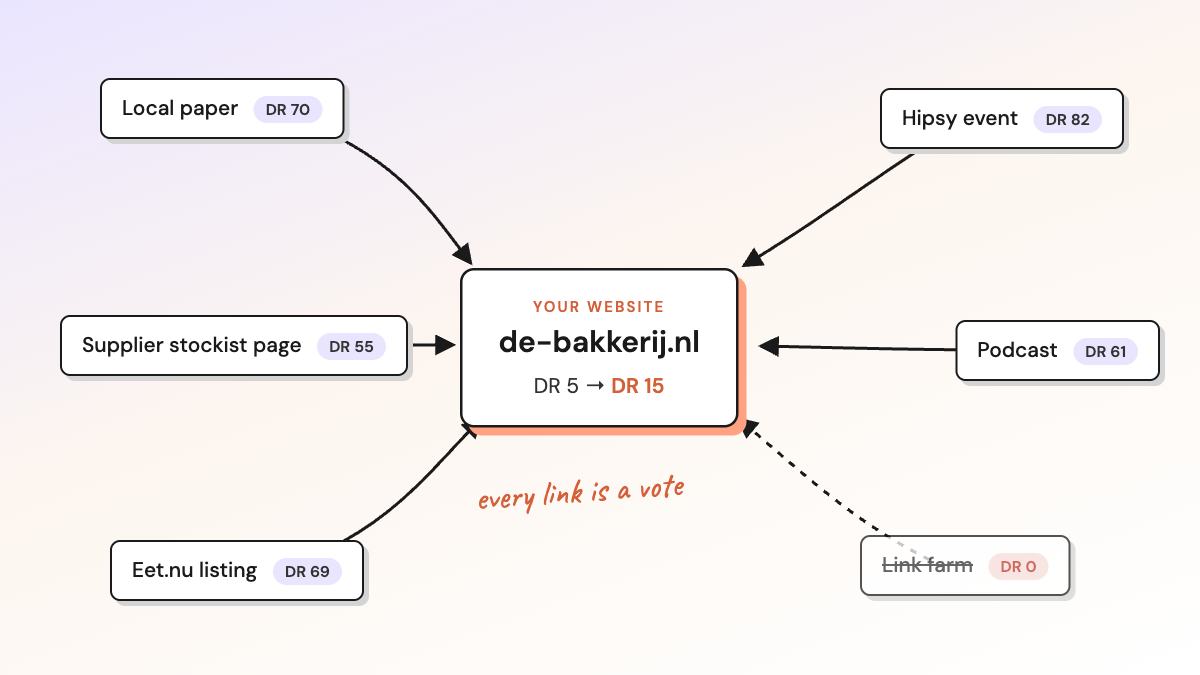
- Backlinks are links from other websites to yours. For Google, they’re votes that you’re real and worth ranking. A new site starts with zero votes.
- Before you chase any links, check you’re actually in Google’s index. “My site doesn’t show up” is usually an indexing problem, and links can’t fix that.
- You need fewer than you think: 5 to 8 relevant links is a meaningful first-year target for a local business. One link from your local paper beats 500 directory submissions.
- The best free links come from things you’d do anyway: your suppliers, your booking software’s testimonial page, the club you sponsor, the events you host, the journalist who needs a quote.
- Never pay for links from a cold email. The going rate for one legitimately earned link at an agency is $1,000 to $2,000, so the €99 bundle of fifty is, by simple arithmetic, junk.
What backlinks are, in one paragraph
A backlink is a link on someone else’s website that points to yours. Google’s original insight, the one that made it Google, was that links work like citations: if lots of relevant, trustworthy sites point to you, you’re probably relevant and trustworthy too. Twenty-five years later that’s still one of the strongest levers in ranking, especially for a new domain that has no other evidence going for it. Links from your own site to your own site don’t count. Sorry.
One nuance before we start: backlinks are the lever for Google. AI search runs on different rules, where being mentioned and being readable matter more than raw authority. I’ve written a full guide to showing up in AI search about that half of the story. The good news: almost every tactic below produces a mention and a link at the same time, so the work pays twice.
First: make sure Google can see you at all
The most common “I need backlinks” panic is actually an indexing problem. Google hasn’t put your site in its index yet, so nothing else matters.
Ten minutes, once:
- Set up Google Search Console. It’s free, it’s Google’s own dashboard for your site, and every step of this article gets easier with it.
- Submit your sitemap (your web person can point you to it, usually
yourdomain.nl/sitemap-index.xml). - Search
site:yourdomain.nlon Google. If pages show up, you’re indexed. If nothing shows up after a few weeks, something is wrong at the technical level, and no quantity of backlinks will fix it.
New sites can take days to weeks to get indexed. That waiting period is a feature of this plan: it’s exactly the time to do the foundation round below.
Second: collect the links you already have
Before chasing new links, find the ones that exist. Businesses almost always have a few they never asked for: an old news item, a supplier’s stockist page, an event listing from 2024.
Free ways to look, no paid tools required:
| Tool | What it shows | Catch |
|---|---|---|
| Google Search Console → Links | Every link Google knows about, to your site | Your site only |
| Ahrefs Webmaster Tools | Full backlink profile + your Domain Rating | Your own verified site only |
| Bing Webmaster Tools | Same idea, Bing’s index | Also feeds ChatGPT’s search |
| Ahrefs/Semrush free checkers | Top ~100 links of any site | Great for peeking at competitors |
While you’re in there, look up two or three competitors who outrank you. Their links are a shopping list: if the local business association links to them, it can link to you too.
How many links do you need, and how long does this take
The honest numbers, because nobody publishes them for small businesses:
- How many: there’s no magic number, it depends on what the top 5 for your search term have, and for most local searches that’s very few. A realistic first milestone is 5 to 8 relevant referring domains plus a well-maintained Google Business Profile. After that, a steady drip of a couple per month is a perfectly healthy pace.
- How long: a new link typically takes around 10 weeks to move rankings, and a brand-new domain takes 6 to 12 months to build stable visibility. Anyone promising faster is describing something Google penalizes.
Write those numbers down somewhere, because they’re your armor for the scam section later. Slow is what real looks like.
What makes one link worth a hundred others
Four things, in order:
- Relevance. A link from a Utrecht city blog to a Utrecht café is worth more than a link from a random tech site with triple the authority. Topical relevance (health site → physio) works the same way.
- A real site with real readers. Google’s systems are good at spotting pages that exist purely to hold links. Ask “would a human find this page useful?” before celebrating.
- Placement. A link inside an actual article beats a link in a footer, sidebar or comment.
- Natural anchor text. The clickable words should mostly be your business name or your URL. If every link to you says “beste fysiotherapeut Amsterdam”, that reads as manipulation, because it is.
And the eternal question, dofollow vs nofollow: some links carry a nofollow tag telling Google to discount them. Those links still bring visitors, brand mentions and AI visibility, and a normal link profile contains plenty of them. Take the nofollow link from the good website over the dofollow link from the junk one, every time.
DR: the number this article keeps using
You’ll see “DR” next to every site I recommend, so here’s the two-minute version.
Domain Rating is a 0 to 100 score from Ahrefs that estimates how strong a website’s backlink profile is. The more quality sites link to a domain, the higher its DR. Google doesn’t use DR (it publishes no authority score at all), but it’s a decent proxy for the thing Google does measure, which makes it the industry’s shared shorthand for “how much does a link from here count”.
Three things worth understanding about it:
- It’s circular in a useful way. Links from high-DR sites raise your DR, and your DR rises as you collect links from more unique domains. Every tactic in this article compounds: the local paper link (DR 70-something) doesn’t just help the page it points at, it makes your whole domain look stronger, which lifts every page you publish afterwards.
- The scale is logarithmic. Going from DR 0 to 20 takes a handful of decent links. Going from 60 to 70 takes hundreds. A new business site sitting at DR 5 after a few months is normal, and a jump to 15 is real progress, not failure.
- It can be gamed, so never read it alone. Spammers inflate DR with junk links, which is why a DR 60 site with no actual visitors is a red flag (see the buying section). DR plus real traffic plus real relevance is the full picture.
Checking it is free. Ahrefs Webmaster Tools shows your own site’s DR and full link profile once you verify ownership, and Ahrefs’ free DR checker gives you the score of any domain, handy for sizing up a directory, a partner site or a competitor in ten seconds. Watching your own DR creep up over the months is also the easiest way to see this whole article working.
Start here: the foundation round
One afternoon, once. Use the exact same business name, address and phone number everywhere, consistency is the whole game here.
1. Google Business Profile
The single highest-impact listing that exists. Claim it, verify it, fill in everything, add photos. Reviews live here too, and for a local business this profile does more for visibility than the next ten tactics combined.
2. Bing Places
Rebuilt by Microsoft in late 2025, and the new portal imports straight from your Google profile in minutes. Worth it alone because Bing feeds ChatGPT’s web search.
3. Apple Business Connect
Puts you on Apple Maps, the default for every iPhone. Half your customers, roughly.
4. Social profiles
LinkedIn company page, Instagram, Facebook page, Pinterest if you’re visual, YouTube if you have video. Fill in the website field on each. These links are nofollow, and they’re still worth doing once: they anchor your brand across the web for both Google and AI engines.
5. The directory round
Ten to twenty good directories, then stop. More is a spam signal, and Google says so explicitly. For the Netherlands I’ve done the homework for you, the full verified list is below.
6. Your tech’s showcase
The platforms your business runs on love showing off their users. This site is built with Astro and listed in the Astro showcase, a DR 90 website. The link is nofollow, and it’s still worth the five minutes: a brand mention on a major platform, referral visitors, and a credibility line for your own site. Your booking system, webshop platform, theme and point-of-sale very likely have a customer showcase, a “wall of love” or a case study page. One email to ask.
Beg, borrow and steal
The fastest real links come from people who already know you. Nothing to create, nobody to convince, just asking.
7. Give testimonials to tools you already use
One of the best minutes-to-value ratios in this whole article. Your accountant, your coffee machine supplier, your booking software: companies publish customer quotes with a name and a link. Email them: “happy to give you a testimonial.” They almost never say no.
8. Get on your suppliers’ stockist pages
Every brand you stock or partner with likely has a “where to buy” or “our partners” page. Those pages exist to link out. Send your URL, logo and a one-liner.
9. Partner with your neighbours
The physio, the gym and the running store recommend each other. The café stocks the local roaster and both say so online. A handful of genuine cross-links between complementary local businesses is natural and useful. (A page of 40 traded links is a link scheme. Google wrote that rule down. Keep it to real partners.)
10. Reclaim mentions you already earned
Set a Google Alert on your business name, two minutes, works forever. Whenever someone writes about you without linking, you’ll know, and a friendly two-line email (“thanks for the mention, would you mind adding the link so readers can find us?”) converts remarkably well.
11. Say yes to every feature
Founder interviews, “women in business” series, chamber-of-commerce member spotlights. These series exist everywhere and they’re perpetually short on subjects. Say yes to all of them, and pitch yourself to a few.
Talk to the press
The most valuable links in this article live here: real editorial links from sites with real authority. They cost effort instead of money.
12. The local paper needs your news
Local papers and city blogs structurally need filler. A new business opening, an anniversary, an unusual niche, a charity tie-in: that’s their content, and their links are exactly the relevance-plus-authority combination you want. Skip the paid press release services (their links are worthless by Google’s own rules) and email the specific journalist who covers your beat, directly, with a short pitch and a good photo.
13. Answer journalist requests
Reporters post callouts for sources, you answer, you get quoted with a link from a news site. Fun fact that proves how stale most SEO advice is: HARO, the best-known platform, shut down in December 2024, and half the internet still recommends it. It came back in April 2025 under new owners as a free email digest. Sign up for HARO, Source of Sources (run by HARO’s original founder), and Featured. Answer only what you’re genuinely qualified for, fast, in the format asked.
14. Guest on podcasts
Search Spotify for local and niche shows, pitch a specific topic, reference an actual episode so they know you listened. Show notes nearly always link, and you get an “as heard on” for your own site.
15. Get into the “best X in [city]” roundups
Find the articles that already rank for “beste [what you do] [your city]”. They get refreshed yearly, and authors are reachable. A short, personal email with a ready-to-use description and a great photo works. Never mention SEO. Offer the experience, an honest visit, a class, a coffee.
Get creative
Make or do something worth pointing at. Highest effort, highest ceiling, and the links arrive on their own.
16. Publish numbers nobody else has
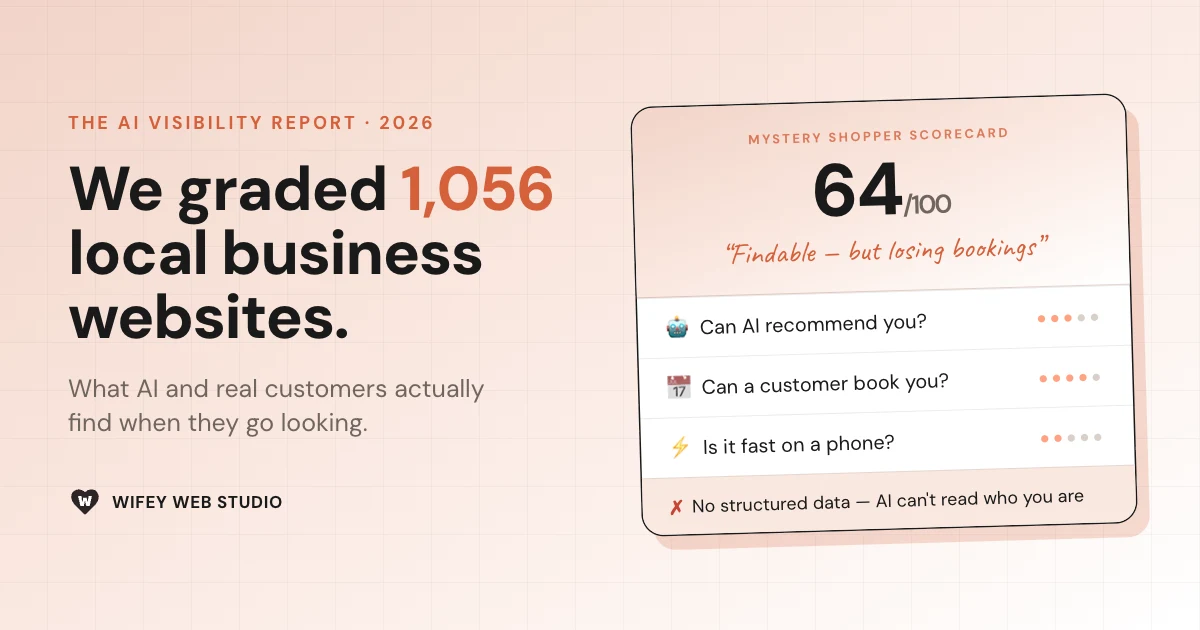
Original local data doesn’t need a research department: “we checked the price of a flat white in all 30 cafés in town” is a dataset. Journalists link to numbers they can cite, and almost nobody produces local ones. I can confirm this works: our audit of 1,056 local business websites is this exact tactic in action.
17. Publish an honest price guide
Owners are scared to publish prices, which is exactly why the few pages that do earn links and AI citations for years. “What does physiotherapy cost in the Netherlands” is a page someone should own. It could be you.
18. Sponsor something small
The local football club, a charity run, the school fair. Sponsors get a logo and link on the sponsors page, and in-kind sponsorship (your product, your service, your venue) counts as much as money. Do it for the community visibility, take the link as the bonus. That framing also happens to be the Google-compliant one.
19. Be the venue, or run the event
If you have physical space, host things: a book club, a workshop, a pop-up. Organizer pages and event platforms link to venues. If you run your own events, list them everywhere free: Eventbrite (DR 83), Hipsy (DR 82, and the platform for workshops, dance and wellness events in the Netherlands), your city’s uitagenda, and your regional VVV’s “evenement aanmelden” form. Local “what to do this weekend” articles are compiled from those calendars, and those articles link.
20. Write the occasional guest post, for humans
Mass guest posting is dead and Google actively penalizes the paid version. What still works: a genuinely useful article on a real site your customers read, the industry association newsletter, the local food blog, a partner’s website. One per quarter, written because you have something to say.
21. Build a /now page
A /now page is a page on your site describing what you’re focused on right now, the way you’d catch up a friend you haven’t seen in a year. Build one at yourdomain.nl/now, keep it honest, then email the URL to Derek Sivers, who runs nownownow.com, the directory of every /now page on the internet. Free listing, DR 82, and the links are direct and followed (I checked the HTML). You have to earn it by actually making the page, which is exactly why it works, and the page itself is a lovely thing to have: customers read it, and it’s the kind of living, personal content AI engines love. I’m on it myself.
Borrow someone else’s platform
SEO people call the aggressive version of this “parasite SEO”, publishing commercial content on big sites to piggyback on their authority, and Google spent 2025 stamping it out. The polite version is fine and useful: keep a presence on high-authority platforms, pointing home.
22. Substack
Links in Substack posts are followed, which makes it one of the few places on this list where a DR 94 platform passes actual link value. Publish your newsletter there, link your website prominently, repost the occasional article. One rule: Substack supplements your blog. If it replaces it, you’re building their domain instead of yours.
23. Medium
Medium’s links are nofollow, so no ranking juice, but it’s still useful: republish your best posts with Medium’s import tool, which sets a canonical tag back to your original (no duplicate-content problems), and you get distribution plus one more high-authority surface where AI engines can find you.
Two more in the same family, both with followed links (I checked the raw HTML): WordPress.com (DR 95) and Blogger (DR 94). Links inside posts on their free plans pass value. The same rule applies to all four platforms: they supplement your own blog, they never replace it.
24. Authory, if you blog under your own name
Authory (DR 76) is a portfolio service for writers: it collects articles published under your byline onto one clean page, each linking back to the original. Those article links pass value, which makes it one of the easiest quality links available, with one requirement: you need authored blog posts on your own site to import. The free plan holds 10 pieces, added manually, which is plenty for a portfolio. One setting to check before you count this one done: new profiles are private by default, which means Google never sees the page or the links. In your profile settings, set it to public and indexable. Ten minutes, done.
Things this list deliberately skips: broken link building, “skyscraper” campaigns, mass outreach. These are agency tactics with single-digit success rates that assume you’re sending 200 emails. You’re not, and you don’t need to.
And the meta-tactic behind all of it: the drip beats the burst. A couple of new referring domains a month, from any category above, forever. That’s the entire strategy.
The Netherlands list: verified, with authority scores
Every Dutch business hits the same problem: you search “gratis bedrijfsvermelding”, find a list from 2019, and spend an evening submitting your details to websites that no longer exist. So I verified the whole landscape by hand and pulled the current Ahrefs Domain Rating (DR, a 0 to 100 authority score) for each one. Some findings from doing that:
- Several directories on popular Dutch “free backlinks” lists score DR 0. They’re dead weight. You’d be typing your address into the void.
- The free press release sites score DR 1 to 22. Skip them entirely, pitch real local press instead.
- The old startpagina ecosystem (startpagina.nl, startkabel.nl) still carries surprisingly high DR from its glory days. One or two relevant dochterpagina submissions are fine and free. Buying startpagina links is a known paid-link market that Google discounts, so never pay.
- KvK myth, busted: your KvK registration does not produce a public backlink, kvk.nl has no linked profile page. But keep your website field updated there anyway, data aggregators pull from it and auto-fill half the directories on this list.
The top of the list, if you do nothing else:
| Listing | DR | Free? |
|---|---|---|
| Google Business Profile | n/a | Free |
| Trustpilot (business profile) | 94 | Free tier |
| Tripadvisor (horeca/tourism) | 84 | Free claim |
| ZorgkaartNederland (health) | 82 | Free profile |
| Infobel | 73 | Free |
| De Telefoongids / Gouden Gids | 70 / 52 | Free listing |
| Drimble | 69 | Free |
| Eet.nu (horeca) | 69 | Free |
| Telefoonboek.nl / Places.nl | 61 | Free listing |
| Openingstijden.nl | 61 | Free |
The full spreadsheet has 100+ rows: general directories in priority order, niche directories for horeca, health, beauty, trades, weddings, kids, fitness, coaches and webshops, the event platforms, the local patterns (ondernemersverenigingen, uitagenda’s, city blogs), and a do-not-bother section, each with DR, cost, effort and checklist columns to track what you’ve done. Every entry links straight to the actual signup page (a third of these sites bury it), and I tested each directory’s outbound links by hand: 25 of the free ones pass real followed-link value, and the sheet tells you which.
The scam field guide
Register a domain and within weeks your inbox fills with SEO offers. This is a known pattern, new registrations get scraped, and the timing is designed to catch you when you’re new at this. Here’s the decoder:
| The email says | It means | You should |
|---|---|---|
| ”50 high-DA backlinks for €99” | Spam links from link farms | Delete |
| ”Guest post opportunity on my network of sites” | Paid links, which Google explicitly penalizes | Delete |
| ”Guaranteed #1 on Google” | Nobody can guarantee this, Google says so itself | Delete, faster |
| ”Your website has 27 critical SEO errors!” | An automated scan designed to scare you | Delete |
| ”I noticed your site doesn’t rank for [keyword]“ | A mail-merge sent to 10,000 businesses | You know what to do |
The arithmetic that makes every one of these easy to ignore: a legitimately earned link, the kind that comes from a real pitch to a real publication, costs an agency $1,000 to $2,000 in labor. Fifty for €99 is off by three orders of magnitude. There is no discount aisle for real links.
What Google actually penalizes, from its own spam policy: buying or selling links for rankings (money, goods or services), excessive link exchanges, automated link programs, and mass low-quality directory submissions. Note that last one: the “we submit your site to 500 directories” service is a literal, named policy violation.
And the panic nobody needs: toxic backlinks. If you peek at your link profile and find spammy sites you’ve never heard of pointing at you, breathe. Every site accumulates these and Google simply ignores them. The scary “toxic link score” is an invention of SEO tools, and Google’s own guidance says most sites should never touch the disavow tool. The only trigger for action is an actual “unnatural links” manual action in Search Console, which you will very likely never see.
If you’re going to buy links anyway
Full disclosure before this section: buying links for rankings is against Google’s guidelines, everything earlier in this article is the safer route, and the free tactics should always be the bulk of your profile. Also true: a large share of SEO runs on paid placements anyway, and if you’re going to be an adult about it, you should at least know what things cost and how not to get ripped off.
The main thing to know: most agencies don’t hand-earn your links. They buy placements from marketplaces, wrap them in a €1,500-per-month retainer, and invoice you the difference. Those marketplaces don’t check who’s ordering, you can make an account yourself. There are plenty of them; one I like is Backlink.nl (25,000+ sites, Dutch and international, including plenty of US publishers) because you can browse the full inventory for free and see exactly which site you’d be buying before paying a cent. On many platforms the URLs stay blanked out until you commit, which tells you something. A decent placement on a real site runs roughly €100 to €300, covering sites up to around DR 75. That’s the entire trick an expensive retainer is selling you.
If you do buy, three rules keep you out of the junk pile:
- Cross-reference every site before paying. DR alone is easy to fake (the marketplace itself says so). Look the site up in a free Ahrefs or Semrush checker: does it have actual organic traffic? A DR 60 site with 40 visitors a month is a link farm wearing a costume. Real traffic, real topical relevance, or no deal.
- Buy like a human, not a bot. One or two placements on genuinely relevant sites, brand-name anchor text, spread over months. Volume and keyword-stuffed anchors are what get profiles flagged.
- Know the risk you’re taking. Small-scale, relevant paid placements mostly go undetected, and mostly is doing real work in that sentence. If Google ignores the link you paid €200 for nothing. If a manual action ever lands, you’ll be cleaning it up. Budget accordingly, emotionally and financially.
Do backlinks matter for AI search?
Yes, and more than people assume. Your customers are increasingly asking ChatGPT instead of Googling, so it’s tempting to think link building belongs to the old world. Two reasons it doesn’t.
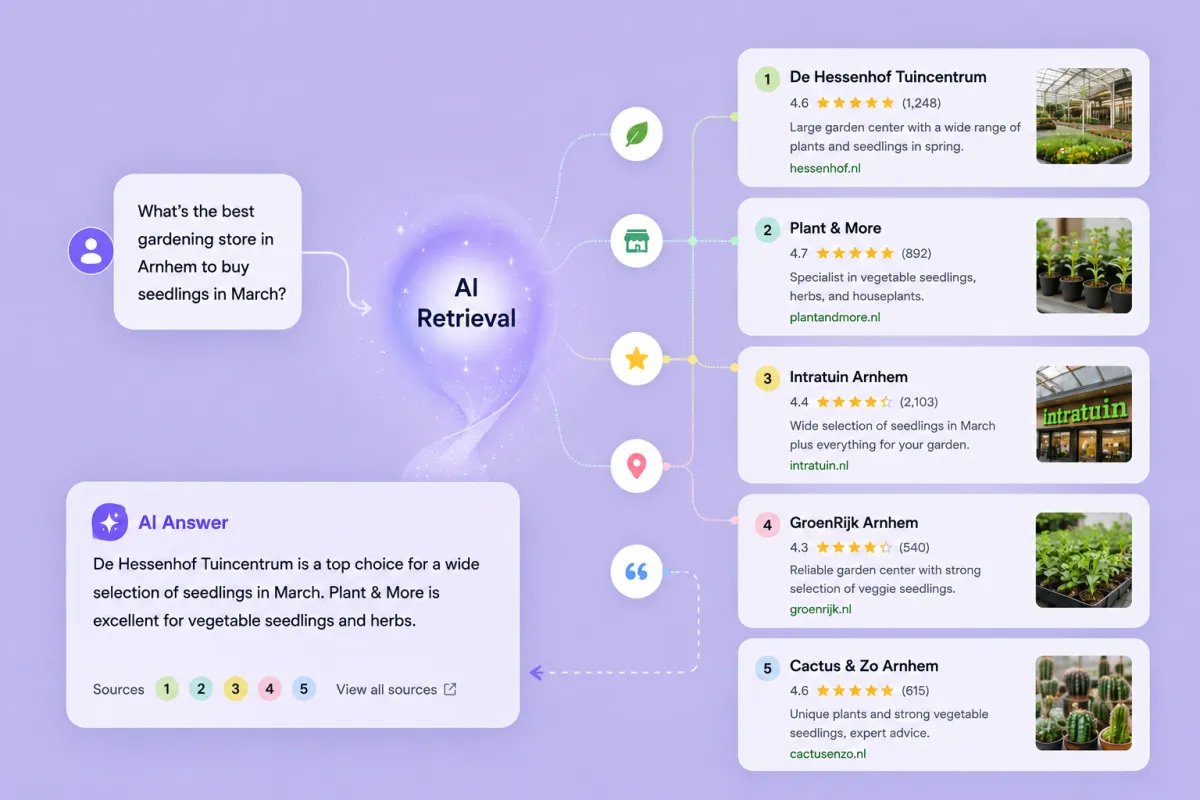
First, the mechanics: when an AI assistant answers “who’s a good physio in Utrecht”, it runs a live web search under the hood, through the same search indexes this whole article is about. Links help decide which pages make that shortlist. If you’re invisible to search, the AI never reads you, so it can never recommend you.
Second, trust: when sources disagree, AI leans toward sites the web already vouches for. Small, low-authority sites genuinely do get cited (structure and specificity matter more here than in classic Google, which is the good news covered in the AI search guide), but between two equally clear answers, the trusted one is the go-to. Links are still how the web expresses trust.
And there’s a third lane on top: mentions. One 2026 analysis of 75,000 brands found that being mentioned across the web correlates about three times more strongly with AI citations than raw backlink counts. Which is convenient, because every tactic above produces a mention and a link in one move. As search shifts toward AI, this work gets more valuable per hour, and less optional.
FAQ
How many backlinks do I need to rank?
There’s no universal number, it depends on your competitors. For most local searches the bar is low: 5 to 8 relevant referring domains plus a strong Google Business Profile is a meaningful first-year target. Quality beats quantity by a wide margin.
How long do backlinks take to work?
Around 10 weeks per link on average, with the full effect over 3 to 6 months. A brand-new domain needs 6 to 12 months to build stable visibility. Plan in seasons, and be suspicious of anyone promising weeks.
Do nofollow links do anything?
Yes. They bring visitors, brand mentions and AI visibility, and since 2020 Google treats nofollow as a hint rather than a hard rule. A natural link profile is full of them.
Do social media links count as backlinks?
They’re all nofollow, so they pass no direct ranking value. Set them up once anyway: they rank for your own name, keep your business details consistent, and feed AI answer engines.
Does posting on social media help my backlinks?
Indirectly, and the indirect part is real. Posting builds zero link equity, but links get earned by people who saw your content somewhere, and for a small business that somewhere is usually social. LinkedIn posts get indexed and reach people who own websites, Pinterest pins drive traffic for years, and posts are brand mentions on surfaces AI engines read (Bing indexes X and LinkedIn and feeds ChatGPT). One niche extra: posting a URL on X can nudge Google to crawl it sooner, which mostly matters for links on slow sites you don’t control. Post where your customers are, treat it as distribution, expect no link juice.
Do directory links still work in 2026?
The good ones, yes, mostly as citations that confirm you’re a real business in a real place. Ten to twenty quality directories help. Beyond that, returns hit zero, and mass submissions cross into what Google’s spam policy explicitly names as a violation.
Can I just buy a few backlinks to speed things up?
It violates Google’s guidelines, and the bulk offers in your inbox are always junk. That said, a real market for placements exists and agencies use it constantly. If you’re going to do it anyway, read the buying section above: marketplace yourself instead of paying a retainer, €100 to 300 per placement, and verify the site has real traffic before paying.
Someone emailed offering guest posts for €50. Scam?
Yes. Paid guest posts with SEO links are precisely what Google’s spam policies and its site reputation abuse crackdown target. Real publications don’t cold-email strangers offering link placements.
Can a competitor hurt me with spam links? Should I disavow?
Almost certainly not. Google ignores junk links automatically, and its own guidance says most sites should never use the disavow tool. Only act if Search Console shows an actual manual action, which is rare.
Are link swaps with other businesses okay?
A few genuine ones, yes: partners, suppliers and neighbours linking to each other is the normal web. Organized swapping at scale (“excessive link exchanges”) is a named policy violation.
Can I rank without any backlinks?
For low-competition local and long-tail searches, genuinely yes, with good content and a strong Google Business Profile. Links become decisive as competition rises. Happily, local business searches sit at the friendly end of that spectrum.
What are citations, and are they the same as backlinks?
A citation is any mention of your name, address and phone number online, with or without a link. For local SEO, consistent citations and actual backlinks both matter, and directory listings usually give you both at once.
Do backlinks matter for ChatGPT and AI search?
Yes. AI assistants retrieve answers through the same link-ranked search indexes, so links shape what the AI reads at all, and when sources conflict, trusted sites win the recommendation. Mentions, structure and specificity matter too, and most link tactics produce those in the same move. See the AI search guide for that side.
How do I check my backlinks for free?
Google Search Console (Links report), Bing Webmaster Tools, and Ahrefs Webmaster Tools for your own site. The free Ahrefs and Semrush checkers show any site’s top links, useful for competitor snooping.
Does it matter if my links come from .nl sites when I sell internationally?
Links from .nl domains help Google connect you to the Netherlands, which is exactly what a local business wants. If you sell internationally, aim for a mix: local links for the map pack, international and industry links for everything else. Relevance to your actual audience is the tiebreaker.
Should I hire someone or do this myself?
For everything in this article: yourself, ninety minutes a week. Consider paying only when you’ve outgrown it (a competitive national niche, a content-led strategy), pay for outreach labor rather than links themselves, and ask any agency to show you the actual placements they’ve earned.
DR scores and prices in this article were checked in August 2026. If you spot a dead directory or a changed price, tell me and I’ll update the list, that’s the whole point of it.